
.svg)
How to build a clear and structured speech
Giving an effective speech requires a rigorous methodology that starts with defining the objective and analyzing the audience. The classic structure includes a catchy introduction, a development organized into key points, and a memorable conclusion. Writing should emphasize clarity, use concrete examples, and incorporate rhetorical elements. Repetition and adaptation of oral delivery transform written text into persuasive communication.
.svg)


To perfect your public speaking skills, also explore our advice on successful oral presentation. If you need professional visual support to accompany your speech, our presentation design agency creates presentations that reinforce your message.
Initial Preparation
Initial preparation constitutes the foundation of every successful speech. This phase determines the orientation, tone, and structure of your intervention. Methodical preparation reduces stress and increases your confidence during presentation.
Defining Speech Objective
Before writing a single word, clearly identify what you wish to accomplish. Do you want to inform, persuade, inspire, or entertain your audience? A precise objective guides your content and style choices. Formulate your objective in one concise sentence that will serve as guiding thread.
Definition: A speech objective is the specific result you wish to obtain from your audience, whether changing their opinions, inciting them to action, or transmitting knowledge.
Common objectives include project presentation, event celebration, cause awareness, or team motivation. Each objective type requires different approach in terms of structure and tone. Motivational speech will use more emotion, while informative speech will favor facts and data.
Types of Speech Objectives
| Objective type | Usage context | Recommended approach |
|---|---|---|
| Informative | Conference, training | Clarity, logical structure, examples |
| Persuasive | Sales pitch, debate | Strong arguments, proof, emotional appeal |
| Inspiring | Ceremony, motivation | Storytelling, values, vision |
| Entertaining | Social event, toast | Anecdotes, humor, lightness |
Audience Analysis
Knowing your audience is as important as mastering your subject. Adapt your vocabulary, references, and detail level according to who is listening. Technical expert audience doesn't have same expectations as general public.
Ask yourself these essential questions: What is their subject knowledge level? What are their main concerns? What examples will resonate with their experience? Age, profession, and cultural context influence message reception.
💡 Key point: An engaged audience is one that recognizes itself in your speech. Use references and examples corresponding to their daily reality to create immediate connection.
Key elements of audience analysis:
- Demographics: age, profession, education level
- Prior knowledge: experts, intermediates, or beginners
- Expectations: what they hope to learn or gain from speech
- Attitudes: favorable, neutral, or skeptical toward your subject
- Context: reason for their presence and state of mind
Time Constraints and Context
Allocated time determines treatment depth. A 5-minute speech allows single main message with two or three supporting points. A 20-minute speech authorizes more nuanced development with detailed examples and controlled digressions.
Physical context also influences your preparation. An amphitheater requires different vocal projection than meeting room. Presence of podium, microphone, or presentation screen modifies your gestures and mobility.
| Duration | Recommended structure | Number of main points |
|---|---|---|
| 5 minutes | Introduction + 1 point + Conclusion | 1-2 points |
| 10 minutes | Introduction + 2-3 points + Conclusion | 2-3 points |
| 20 minutes | Introduction + 3-4 detailed points + Conclusion | 3-4 points |
| 30+ minutes | Introduction + 4-5 points + Interactions + Conclusion | 4-5 points |
Speech Structure
Speech structure follows proven architecture facilitating understanding and memorization. Clear structure guides your audience through your reasoning and maintains their attention from beginning to end.
Introduction and Hook
The first 30 seconds are crucial. Your introduction must capture attention immediately and establish your credibility. Avoid banal formulas like "I'm happy to be here today" that bring no value.
Effective hook techniques: surprising statistic, provocative question, personal anecdote, striking quote, or counter-intuitive statement. Hook must create curiosity pushing audience to want to know more.
⚠️ Caution: Never start with apologies ("I'm not a great speaker") or administrative information ("The day's program"). Capture attention first, practical details can wait.
Essential introduction elements:
1. Hook: capture attention in first 10 seconds
2. Context: explain why this subject is important now
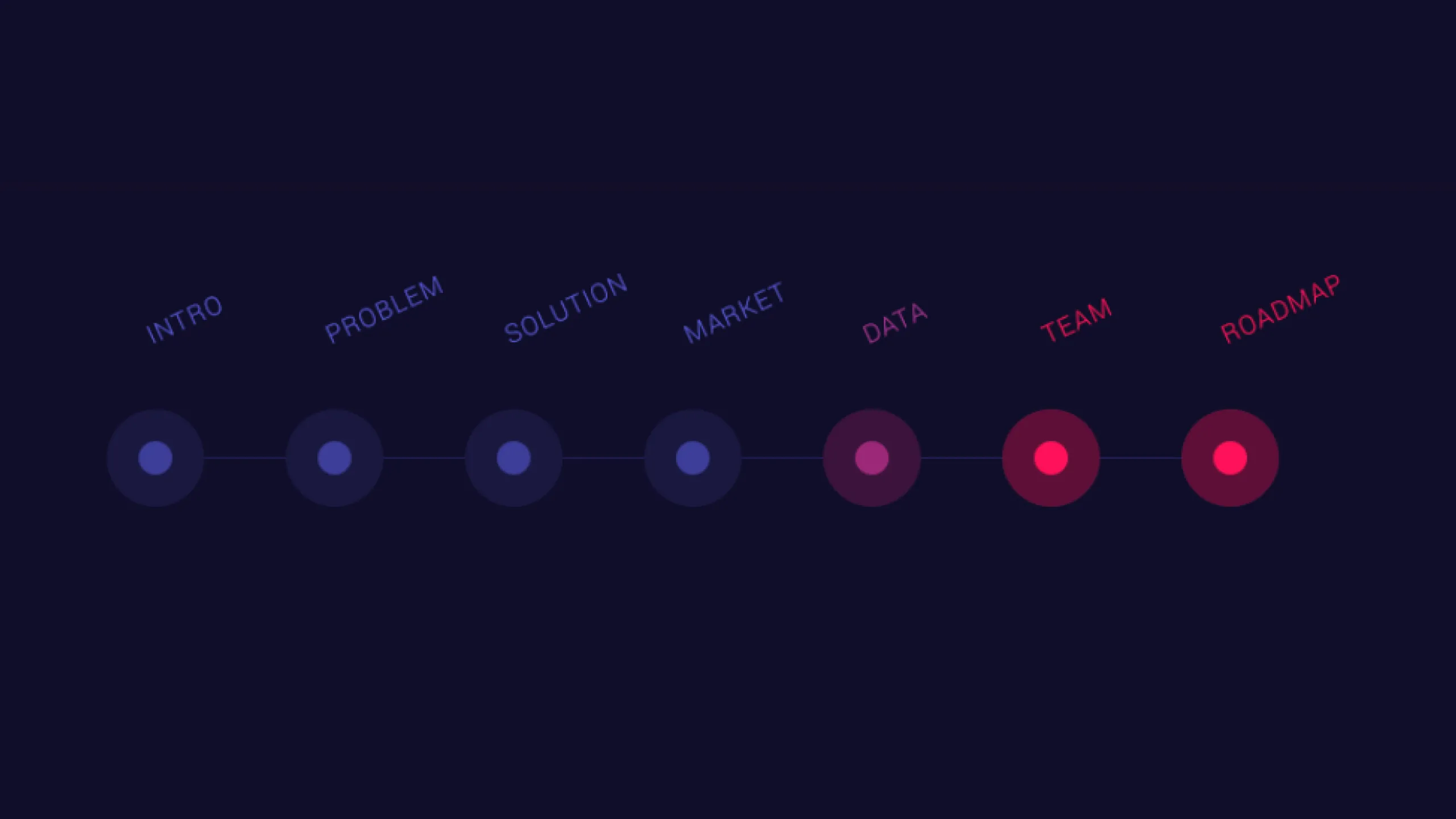
3. Plan announcement: present your speech structure
4. Value promise: what audience will learn or gain
Hook Examples by Speech Type
For informative speech: "Did you know that 75% of PowerPoint presentations lose their audience in first 3 minutes?" To visually structure your temporal progression, consult our guide on how to create PowerPoint timeline.
For persuasive speech: "What if I told you that the decision you make in next 15 minutes could transform your organization?"
For inspiring speech: "Ten years ago, I made the mistake that changed my life. Let me tell you how failure became my greatest lesson."

Speech Body and Arguments
Body constitutes 70-80% of your speaking time. Organize your ideas into 2 to 5 main points maximum to facilitate memorization. Each point must be developed with examples, data, or anecdotes reinforcing your message.
Three classic structures work particularly well: chronological structure (past-present-future), problem-solution structure, and comparative structure (option A vs option B). Choose one that best matches your objective and content.
Argument development methods:
- PEE Method: Point (statement), Example (illustration), Explanation (analysis)
- PREP Method: Point, Reason, Example, Point (repetition)
- Monroe Method: Attention, Need, Satisfaction, Visualization, Action
📋 Quick summary: For each main argument, plan 1-2 minutes of development including clear statement, concrete example, and explanation linking this argument to your global objective.
Conclusion and Call to Action

Conclusion must be as impactful as introduction. It represents your last opportunity to mark minds. Clearly announce your conclusion with transition phrase like "In conclusion" or "To summarize" to mentally prepare your audience.
Recall 2-3 main points synthetically without repeating entire development. Then, launch clear and achievable call to action: what do you want your audience to do after your speech?
Effective conclusion structure:
1. Transition signal: "To conclude", "In summary"
2. Key points recall: synthesis in 3-4 sentences
3. Final message: idea you want to leave
4. Call to action: concrete and achievable action
5. Memorable closing: quote, image, or question
Content Writing
Writing transforms your structure into fluid and convincing text. This phase requires attention to details and sensitivity to speech rhythm, different from writing intended for reading.
Main Ideas Organization
Use mind mapping method to visualize connections between your ideas. Each main idea becomes branch with its sub-arguments and examples. This approach reveals redundancies and gaps in your reasoning.
Prioritize your arguments from strongest to weakest, or inversely according to desired effect. Primacy-recency rule indicates audience retains better what they hear at beginning and end. Place your most important arguments at these strategic positions.
| Position | Impact | Recommended use |
|---|---|---|
| Beginning | High primacy effect | Strongest or most surprising argument |
| Middle | Medium impact | Supporting arguments, technical details |
| End | High recency effect | Emotional argument or call to action |
Examples and Proof Choice
Examples make your abstract ideas tangible and memorable. Favor concrete examples over generalities. Instead of saying "High-performing companies communicate better", cite "When Microsoft reorganized its meetings in 2023, productivity increased by 30%."
Vary your proof types to reinforce credibility: verifiable statistics, case studies, expert testimonials, analogies, and personal anecdotes. Each proof type resonates differently according to audience profiles.
💡 Key point: Personal stories create powerful emotional connection. Even in technical speech, brief anecdote about your experience humanizes your message and makes it more memorable.
Proof types and their impact:
- Statistics: rational credibility, scientific authority
- Case studies: concrete proof, real application
- Expert quotes: external validation, credibility by association
- Personal anecdotes: authenticity, emotional connection
- Analogies: facilitated understanding, complex concept clarification
Rules for Using Numerical Data
Limit numbers to 3-4 maximum statistics per speech. Excess data drowns message. Round numbers to facilitate memorization: "about 75%" rather than "74.3%". Always contextualize with comparison: "75%, that's 3 out of 4 people in this room." To effectively visualize your statistical data, discover how to use pie charts in your presentation materials.
Transitions and Coherence
Transitions are bridges connecting your ideas. Without them, your speech resembles series of disconnected points. Use explicit transition phrases: "Now that we've seen X, let's examine Y" or "This naturally brings us to the question of..."
Create common threads running through your speech. Return to image, expression, or example from your introduction in your conclusion to create satisfying circular structure. This technique reinforces coherence and gives impression of completion.
Effective transition phrases:
- Addition: "Moreover", "Furthermore", "In addition"
- Contrast: "However", "Conversely", "On the other hand"
- Causality: "Therefore", "That's why", "Thus"
- Illustration: "For example", "Concretely", "Take the case of"
- Progression: "Moving now to", "Let's address next", "The second point"
Rhetorical Techniques
Rhetorical techniques transform ordinary speech into memorable experience. These linguistic tools, used since Antiquity, amplify your message and mark minds.
Figures of Style and Anaphoras
Anaphora repeats word or phrase at beginning of successive sentences to create rhythm and reinforce message. Martin Luther King Jr. immortalized this technique with "I have a dream" repeated eight times in his historic speech. To deepen understanding of this powerful figure of style and its applications, explore our complete guide on anaphora.
Other powerful figures include metaphor (implicit comparison), hyperbole (voluntary exaggeration), and synecdoche (part for whole). Used sparingly, these figures enrich your style without falling into artifice.
Definition: Anaphora is figure of style consisting of repeating word or group of words at beginning of successive sentences or clauses to create rhythm and emphasis effect.
Effective anaphora examples:
- "We must innovate. We must adapt. We must succeed."
- "Every day counts. Every decision counts. Every action counts."
- "This is the time to change. This is the time to act. This is the time to succeed."

Storytelling and Emotion
Stories activate more brain areas than facts alone. Well-told story creates emotional connection facilitating memorization and adherence. To master this essential narrative technique, consult our article on storytelling definition and principles. Structure your stories with beginning (context), middle (challenge or conflict), and end (resolution or lesson).
Emotions make your speech human and authentic. Don't hesitate to show your vulnerability through overcome failures or doubts. Public identifies more with imperfect speaker than distant and perfect figure.
| Emotion | Effect on audience | When to use |
|---|---|---|
| Hope | Motivation, optimism | Inspiring speech, future vision |
| Fear | Urgency, awareness | Alert, necessary change |
| Anger | Mobilization, energy | Injustice, need for collective action |
| Joy | Connection, enthusiasm | Celebration, success sharing |
| Surprise | Attention, curiosity | Introduction, revelation |
⚠️ Caution: Authenticity is crucial in storytelling. Never invent stories or exaggerate your experiences. Public quickly detects lack of sincerity, which immediately destroys your credibility.
Rhetorical Questions
Rhetorical questions actively engage audience by forcing reflection on answer. "Can we really afford to wait?" or "Who has never dreamed of success?" create mental dialogue without requiring vocal response.
Use them strategically to introduce new point, question received idea, or prepare revelation. Leave 2-3 seconds of silence after rhetorical question to allow mental reflection.
Rhetorical question functions:
1. Introduce subject: "What does success really mean?"
2. Challenge belief: "Who said it was impossible?"
3. Create anticipation: "What is the solution to this problem?"
4. Engage emotionally: "Isn't this what we all want?"
Delivery Preparation
Best writing isn't enough without mastered delivery. This phase transforms your text into living and convincing oral performance.
Rehearsal and Timing
Rehearse your speech minimum 5 to 7 times before actual presentation. First rehearsals done alone, last ones before test audience providing constructive feedback. Each rehearsal improves your fluency and reduces dependence on notes.
Systematically time your rehearsals. Speech written for 15 minutes often takes 12 or 18 minutes orally depending on your pace. Adjust content rather than speaking faster or slower than your natural rhythm.
📋 Quick summary: Film yourself during rehearsals to identify verbal tics, parasitic gestures, and zones where you hesitate. This self-observation is uncomfortable but extremely effective for rapid improvement.
Optimal rehearsal schedule:
- Rehearsals 1-2: Content familiarization, difficult passage identification
- Rehearsals 3-4: Fluency work, timing adjustment
- Rehearsals 5-6: Body language integration, transition management
- Rehearsal 7+: Real conditions test, final adjustments

Notes and Memory Aids
Never read your speech entirely. Reading creates barrier with audience and prevents adapting to their reactions. Prepare minimal notes with keywords and structure, not complete sentences. If you use PowerPoint for your speech, discover how to use presenter mode to display your notes discreetly.
Use index cards (A6 format) rather than loose sheets that shake and make noise. Number them clearly in case you drop them. Include timing markers at regular intervals to manage your progression.
| Note format | Advantages | Disadvantages |
|---|---|---|
| Index cards | Discreet, stable, easy to handle | Limited space, may require multiple cards |
| A4 sheets | Generous space, easy additions | Visible, can shake, noisy |
| Tablet/screen | Editable, detailed notes | Technical dependence, visual barrier |
| Pure memorization | Maximum contact, fluidity | Memory lapse risk, stress |
💡 Key point: Structure your notes with color codes: titles in blue, statistics in red, transitions in green. This visual system accelerates spotting while speaking and reduces time spent looking at notes.
Stress Management
Stress before speech is normal and even beneficial in moderate dose. Adrenaline improves your energy and concentration. Problem arises when stress becomes paralyzing and harms your performance.
Proven management techniques: deep breathing (inhale 4 counts, exhale 6 counts), positive visualization (imagine successful presentation), and physical anchoring (adopt power posture 2 minutes before going on stage).
Anti-stress strategies by phase:
- One week before: thorough preparation, regular rehearsals
- Day before: relaxation, sufficient sleep, avoid excessive alcohol and caffeine
- One hour before: light note review, breathing exercises
- 5 minutes before: power posture, positive self-talk
- During: eye contact, controlled breathing, focus on message
Presentation Techniques
Oral delivery transforms your written text into living experience. These presentation techniques maximize your impact and maintain audience engagement from beginning to end.
Voice and Intonation
Your voice is your main instrument. Vary volume to create emphasis, pace to control energy, and tone to convey emotion. Monotone speech, even with excellent content, quickly loses audience.
Pauses are as important as words. 2-3 second pause after important point allows reflection time. Pause before revelation creates anticipation. Silence is powerful rhetorical tool often underused.
⚠️ Caution: Vocal tics like "uh", "so", "actually", or "you know" dilute your message and project lack of confidence. Replace them with brief silent pauses that will appear natural and professional.
Vocal parameters to master:
- Volume: loud for emphasis, soft for intimacy
- Pace: fast for energy (150-180 words/min), slow for gravity (100-130 words/min)
- Pitch: varied to avoid monotony, adapted to content
- Articulation: clear without being excessive, word ending accentuation
Body Language
Your body communicates as much as your words. Adopt open posture: shoulders back, feet shoulder-width apart, arms uncrossed. This posture projects confidence and accessibility. Avoid swaying, crossing arms, or putting hands in pockets.
Gestures should be natural and reinforce your words. Use your hands to illustrate dimensions, indicate progression, or emphasize point. Gestures at chest and face level are more visible and expressive than those near body.
| Gesture | Meaning | When to use |
|---|---|---|
| Open palms | Honesty, transparency | Main arguments, trust appeal |
| Hands joined | Reflection, seriousness | Complex points, grave moments |
| Pointing (open) | Direction, emphasis | Enumeration, choice indication |
| Descriptive gestures | Illustration, size | Concrete examples, physical metaphors |
💡 Key point: Eye contact creates individual connection even in large group. Look at specific people for 3-5 seconds before moving to another, progressively sweeping entire room so everyone feels concerned.

Audience Management
Engaged audience is one that participates, even silently. Read non-verbal signals: head nods (understanding), frowns (confusion), crossed arms (resistance). Adapt your speech in real-time according to these feedbacks.
Engagement techniques: ask show-of-hands questions, request audience examples, create individual reflection moments. Interaction transforms monologue into conversation and maintains attention longer.
Responses to common situations:
- Distracted audience: change vocal register, ask question, move in space
- Hostile question: stay calm, reformulate positively, thank for perspective
- Insufficient time: jump to conclusions, summarize untreated points, offer to continue after
- Technical problem: keep calm, continue without support, use humor if appropriate
Frequently Asked Questions
How much time is needed to prepare 10-minute speech?
Preparing 10-minute speech generally requires 8 to 12 hours total work, including research, structure, writing, and rehearsals. This preparation ratio increases with presentation stakes and decreases with your experience.
Should I memorize my speech word for word?
No, memorizing word for word creates rigidity and increases memory lapse risk. Rather memorize general structure and key transitions, then let words come naturally. This approach allows real-time adaptation and maintains authenticity.
How to handle memory lapse during speech?
Stay calm and use recovery technique: reformulate your last idea differently, consult your notes without apologizing, or ask rhetorical question to gain time. Public often doesn't notice small hesitations if you don't highlight them.
What is ideal length for speech?
Optimal duration depends on context, but 15-20 minutes represents excellent balance between content depth and attention maintenance. Beyond 30 minutes, integrate interactions or breaks to relaunch public engagement.
How to adapt my speech to hostile or skeptical audience?
Acknowledge their concerns from introduction, use objective rather than emotional proof, present multiple perspectives before defending yours. Respect and transparency often disarm initial resistance better than forced argumentation.
Should I use PowerPoint or other visual supports?
Visual supports enrich speech but should never replace it. Use them for complex data, diagrams, and evocative images, but avoid slides loaded with text you simply read. Principle: your slides support your words, not inverse.
How to end speech memorably?
Create circular closure by returning to your opening hook, use powerful quote summarizing your message, or launch concrete challenge to your audience. Last words remain in memory: choose them with as much care as your first.
.webp)


